Sarnath
Where the Buddha gave his first sermon, 10 km from Varanasi

After his enlightenment at Bodh Gaya, the Buddha walked about 250 km to a deer park at Sarnath, where five former companions were living as ascetics. Here he gave his first teaching, setting in motion the wheel of the dharma, and the five became the first monks. Sarnath is one of the four main pilgrimage sites of Buddhism, with Lumbini, Bodh Gaya and Kushinagar.
The emperor Ashoka visited in the 3rd century BCE and raised a polished stone pillar topped by four lions. That Lion Capital is now India's national emblem and stands in the Sarnath Museum. Monasteries grew here for more than a thousand years, until the site was abandoned in the 12th century. Excavations from the 19th century uncovered the brick foundations you walk through today around the great Dhamek Stupa.
Modern Sarnath is calm and green, a contrast to the intensity of Varanasi. Temples built by Sri Lankan, Thai, Tibetan, Japanese and Chinese communities line the roads, and the Mulagandha Kuti Vihara, built in 1931, holds evening chanting. There is no luxury hotel here, so we visit from Taj Nadesar Palace or BrijRama Palace, usually in the afternoon so you can stay for the evening prayers.
Highlights
What Sarnath does best
A solid cylinder of stone and brick about 43 m high and 28 m across, rebuilt around 500 CE on the spot linked to the first sermon. Its lower band is carved with fine floral and geometric patterns, and pilgrims walk around it chanting.
Four lions back to back on a drum carved with a horse, a bull, an elephant and a lion, polished to a glassy shine in the 3rd century BCE. It is India's national emblem and the centrepiece of the Sarnath Museum, closed on Fridays.
Brick foundations of monasteries, shrines and votive stupas spread across the deer park, along with the stump of Ashoka's pillar. Walking through them with a guide shows how large the monastic community once was.
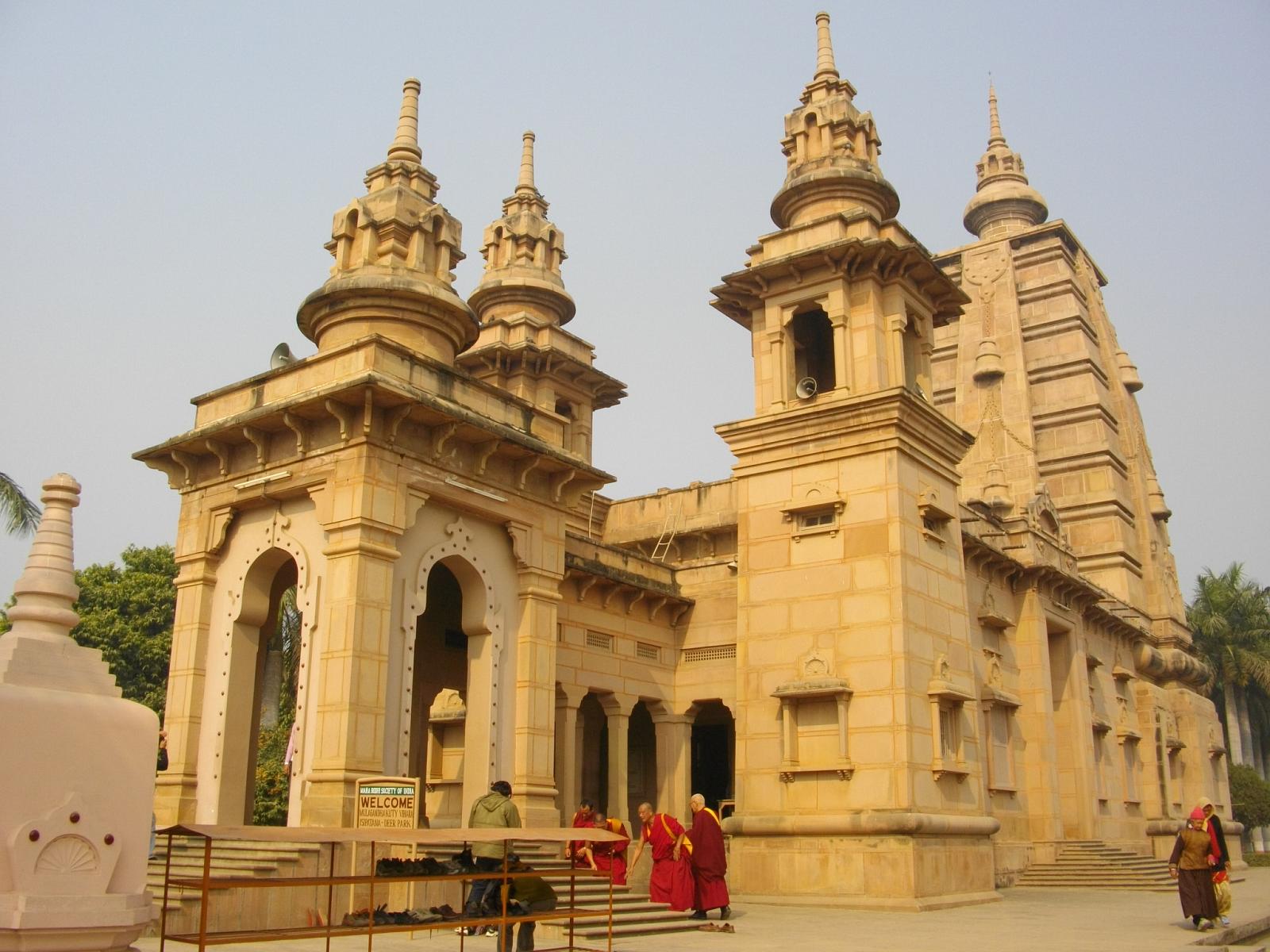
A temple built in 1931 by the Maha Bodhi Society, with murals of the Buddha's life painted by the Japanese artist Kosetsu Nosu. Monks chant here in the evening, and a Bodhi tree grown from a cutting of Sri Lanka's sacred tree stands outside.
A brick stupa marking where the Buddha met his five companions, topped by an octagonal Mughal tower added in 1588 to record a visit by the emperor Humayun. It is a short stop on the road in from Varanasi.
Experiences
Four hours to plan around




Getting there
How to reach Sarnath
Varanasi airport (VNS) is about 30 km away, roughly 45 minutes to an hour by car. Most visitors come from a Varanasi hotel.
Sarnath has a small station with few useful trains. Arrive at Varanasi Junction or Banaras and drive 10 km.
From the Varanasi cantonment, where Taj Nadesar Palace stands, Sarnath is about 8 km and 30 minutes. From the ghats allow 45 minutes in traffic.
Where to stay
Rooms we book
Sarnath has a few simple guesthouses and monastery rest houses but no luxury hotel, so we base guests in Varanasi. Taj Nadesar Palace and Taj Ganges in the cantonment are the closest of the good hotels, about 30 minutes away, and make an afternoon visit with evening chanting easy. BrijRama Palace on the ghats is about 45 minutes away. Pilgrims on a longer Buddhist circuit sometimes stay at monastery guesthouses for the atmosphere, which we can arrange.

A small former royal guest house of the maharajas of Benares, set in large gardens in the Varanasi cantonment. With only a handful of suites, it …
A large Taj hotel in the Nadesar Palace grounds in the Varanasi cantonment, with a big pool, gardens and family-friendly facilities, about 30 minutes from the …
Shape your own journey Tell us your dates and what you hope to feel. We draw the route around you. Begin Not sure where to start? We match the land to your month, your pace and the people travelling with you. Begin Talk to a planner A first route and an indicative price within one working day. No payment to start. BeginFrom our planners
Five things to know
- The Sarnath Museum is closed on Fridays, so plan your visit for another day.
- Photography is not allowed inside the museum, and bags must be left in the cloakroom.
- Walk clockwise around stupas and temples, as Buddhist pilgrims do.
- Visit in the afternoon and stay for the chanting at Mulagandha Kuti Vihara around dusk.
- Buddha Purnima in April or May brings large pilgrim crowds and special ceremonies; check current status before you travel.
Questions travellers ask
Questions about Sarnath
Why is Sarnath important in Buddhism?
Sarnath is where the Buddha gave his first sermon after reaching enlightenment at Bodh Gaya, teaching the Four Noble Truths to five former companions who became the first monks. It is one of the four main Buddhist pilgrimage sites, along with Lumbini, Bodh Gaya and Kushinagar. Ashoka later built stupas and a pillar here.
How much time do I need at Sarnath?
A half-day is enough: about three to four hours for the archaeological park, the Dhamek Stupa, the museum and one or two temples, plus 30 to 45 minutes each way from Varanasi. Pilgrims who want to meditate or join the chanting often stay into the evening.
Is the Sarnath Museum closed on Fridays?
Yes, the Sarnath Museum is closed on Fridays. The archaeological park with the Dhamek Stupa is open every day from sunrise to sunset. If your only free day in Varanasi is a Friday, you can still visit the stupa and temples but will miss the Lion Capital.
Can I stay overnight in Sarnath?
There are simple guesthouses and monastery rest houses in Sarnath, but no luxury hotels. Most travellers stay in Varanasi, about 30 to 45 minutes away, at Taj Nadesar Palace, Taj Ganges or BrijRama Palace. Pilgrims seeking a quieter, monastic setting can stay at a monastery guesthouse, which we arrange on request.
What is the best time of day to visit Sarnath?
Afternoon into evening. The light is warm on the Dhamek Stupa, tour groups have usually left and you can stay for the chanting at Mulagandha Kuti Vihara at dusk. Mornings suit those combining Sarnath with an afternoon in Varanasi. Avoid Fridays if you want the museum.
Is there an entry fee for Sarnath?
The archaeological park and the museum each charge a modest entry fee, set by the Archaeological Survey of India, with higher rates for foreign visitors. The modern temples are free, though donations are welcome. Check current status before you travel, as ASI fees change from time to time.
What should I wear at Sarnath?
Modest clothing covering shoulders and knees, and shoes that slip off easily for temples. The site is mostly level, with paved and gravel paths. In winter, late afternoons cool quickly, so bring a layer for the evening chanting. In April and later, a hat and water are essential.
How does Sarnath fit into a Buddhist circuit tour?
Sarnath usually starts or ends the Indian circuit, paired with Varanasi. A typical route is Varanasi and Sarnath, then Bodh Gaya (about 250 km), Rajgir and Nalanda, Vaishali and Kushinagar. Lumbini in Nepal can be added from Kushinagar, but our circuit stays within India.
Can I see the Bodhi tree at Sarnath?
Yes, there is a Bodhi tree beside Mulagandha Kuti Vihara, grown from a cutting of the Sri Maha Bodhi at Anuradhapura in Sri Lanka, which tradition says came from the original tree at Bodh Gaya. The principal Bodhi tree, at the place of enlightenment, is at the Mahabodhi Temple in Bodh Gaya.
Nearby
Pair it with
Dawn boats, evening aarti and the oldest lanes on the Ganges

The Bodhi tree and the Mahabodhi Temple in Bihar

Where the Buddha passed away, under twin sal trees
Shape your own journey Tell us your dates and what you hope to feel. We draw the route around you. Begin Not sure where to start? We match the land to your month, your pace and the people travelling with you. Begin Talk to a planner A first route and an indicative price within one working day. No payment to start. Begin