Chitwan
Rhinos, gharials and sal forest in Nepal's first national park

Chitwan lies in the Terai, the flat strip of southern Nepal along the Indian border, about 150 m above sea level. The park fills the valley between the Rapti, Narayani and Reu rivers and the low Siwalik hills, with sal forest on the higher ground and tall elephant grass along the rivers. It was declared Nepal's first national park in 1973, after decades as a royal hunting reserve, and listed by UNESCO in 1984. It now protects one of the largest populations of greater one-horned rhinoceros anywhere.
Rhinos are the reliable sight: on a full day's jeep safari in the dry season most guests see several. The park also holds Bengal tigers, which are present in good numbers but rarely seen, leopards, sloth bears, gaur, four kinds of deer, two crocodiles, the mugger and the fish-eating gharial, and a long list of birds, from hornbills to the Bengal florican. The experience is quieter than an Indian tiger reserve: canoes, walks and long silences rather than a race between jeeps.
Where you stay shapes what you see. Sauraha, on the north-east edge, is the busy backpacker hub. Our guests stay on the western side, near Meghauli and Amaltari, where the Rapti and Narayani meet, the grasslands are wide and fewer vehicles enter the park. Three nights allows two full days: a long jeep safari, a canoe trip, a guided walk, a Tharu village visit and birding at dawn. We do not book elephant rides, and we choose lodges that share that view.
Highlights
What Chitwan does best
Chitwan is the best place in Nepal, and one of the best in Asia, to see the greater one-horned rhinoceros in the wild. In the dry months they graze the open grasslands and wallow in pools near the rivers, often within 20 to 30 metres of the jeep.
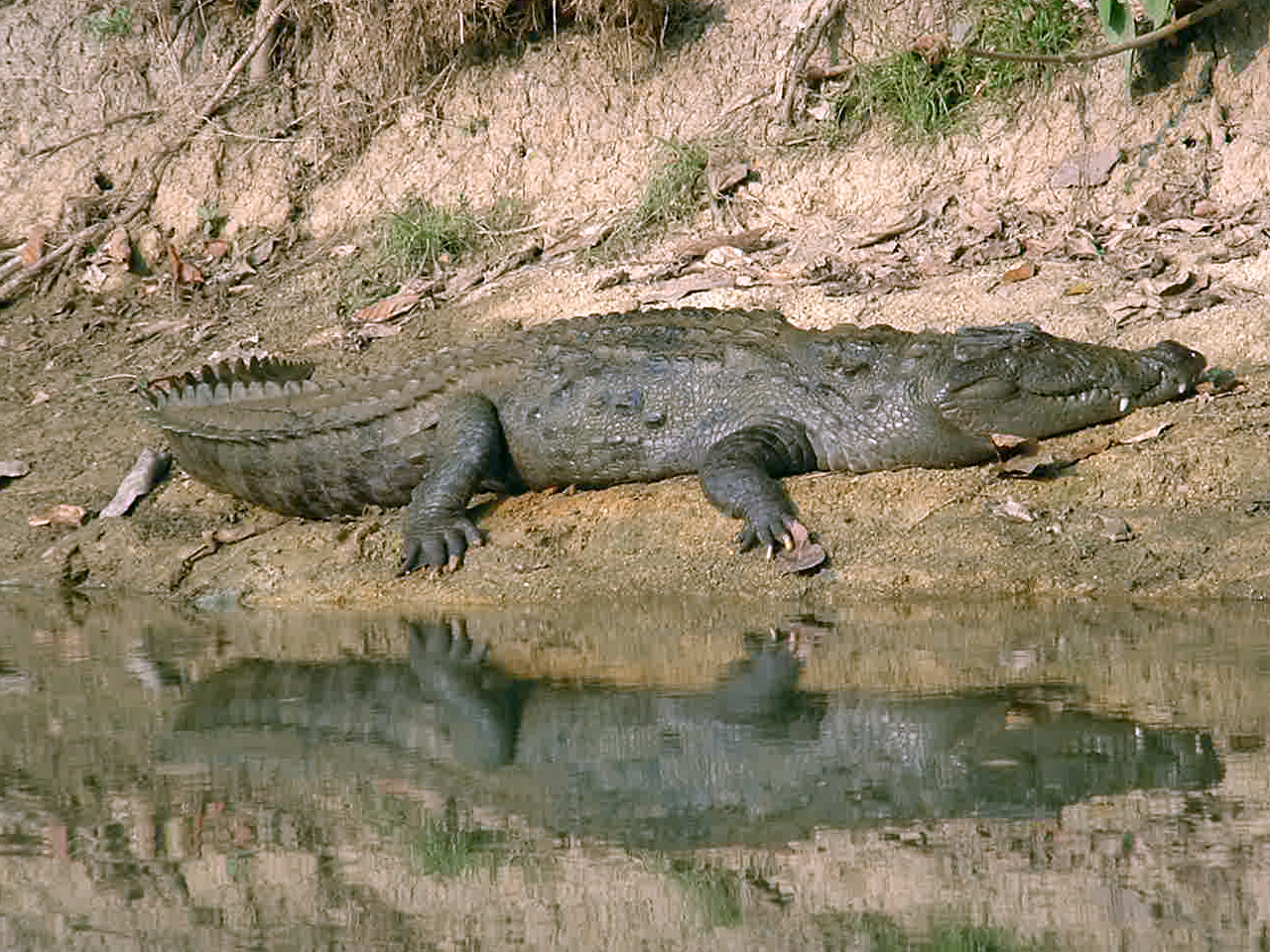
A long, narrow canoe cut from a single silk-cotton trunk drifts downstream for an hour or two with a boatman and naturalist. Mugger crocodiles bask on the banks, gharials sometimes surface, and kingfishers, storks and herons hunt along the edges. It is the quietest way to enter the park.
The slender-snouted gharial is critically endangered. At Kasara, park headquarters, a breeding centre raises young gharials for release into the Rapti and Narayani. A short visit explains the work and gives a close look at animals that are hard to see well in the wild.
The Tharu have lived in the Terai for centuries, long before malaria control opened it to settlement. Their mud-and-reed houses, painted granaries and fishing traps are still found around the park. We visit villages near our lodges with Tharu guides, where a family will show how they cook and farm.
With forest, grassland, rivers and lakes side by side, Chitwan is among the best birding sites in South Asia. Early-morning walks and drives turn up hornbills, parakeets, bee-eaters, ibises, eagles and, in the grasslands, the rare Bengal florican. Winter adds many migrants from the north.
Our base is Meghauli Serai, a Taj Safari lodge on the Rapti River on the western side of the park, with Tharu-inspired design and a pool facing the river. Rhinos sometimes graze across the water in view of the terrace, and park entry points are a short drive away.
Experiences
Four hours to plan around




Getting there
How to reach Chitwan
Flights from Kathmandu to Bharatpur (BHR) take about 25 minutes. From Bharatpur it is about 1 to 1.5 hours by road west to Meghauli Serai and the other lodges around Meghauli and Amaltari. Flights are short but can be delayed by winter fog in December and January, so we avoid tight connections.
Kathmandu to Chitwan is about 165 km and 5 to 6 hours by private car, descending the Trishuli valley to Mugling and then south along the Narayani. Traffic and roadworks on this route are common. We often break the drive with lunch on the way or combine it with the Manakamana cable car.
Pokhara to Chitwan is about 150 km and 4 to 5 hours by private car, following the Seti and Trishuli valleys down to Mugling and Narayanghat. It is the usual link on journeys that combine the Himalaya with wildlife. Lumbini is a further 4 to 5 hours south-west if you are continuing to the Buddhist sites.
Where to stay
Rooms we book
Stay on the western side of the park, away from the crowds of Sauraha. Meghauli Serai, A Taj Safari, sits on the Rapti River near Meghauli with Tharu-inspired architecture, a riverside pool and its own naturalists. Nearby, Tiger Tops Tharu Lodge at Amaltari is built in the style of Tharu longhouses, and Barahi Jungle Lodge is also on the river near Meghauli. Kasara Resort sits close to the park headquarters. All arrange jeep, canoe and walking safaris inside the park.
A Taj Safaris lodge on the banks of the Rapti River in western Chitwan, facing the national park across the water. Rooms and villas draw on …
Shape your own journey Tell us your dates and what you hope to feel. We draw the route around you. Begin Not sure where to start? We match the land to your month, your pace and the people travelling with you. Begin Talk to a planner A first route and an indicative price within one working day. No payment to start. BeginFrom our planners
Five things to know
- Wear neutral greens and browns on safari and avoid bright white, red or perfume, which carry far in the forest.
- Bring a light fleece for early-morning drives from December to February, when Terai fog and open jeeps make it cold before 9 am.
- Plan Chitwan after the grass-cutting in late January and February if seeing animals in open country matters more to you than mild weather.
- Book at least two full days; tigers are seen by only a small share of visitors, and rhinos and birds are better with time.
- We do not book elephant rides; jeep, canoe and walking safaris with trained naturalists show the park better and with less harm.
Questions travellers ask
Questions about Chitwan
How many nights should we spend in Chitwan?
Three nights is ideal: it gives two full days for a jeep safari, canoe trip, walk and village visit, without rushing. Two nights works if time is short, but leaves only one full day. Keen wildlife watchers and photographers should consider four, or combine Chitwan with Bardia in the far west for a better chance of tigers.
When is the best time to visit Chitwan?
October to March is the most comfortable, with mild days and cool mornings. February to April is best for seeing animals, after the grass is cut and as water becomes scarce, though April is hot. May and June are very hot. From July to September monsoon rain floods tracks and many lodges reduce operations or close.
Is Chitwan better than Bardia?
Chitwan is easier to reach, has more lodge choice and is excellent for rhinos, birds and canoe trips. Bardia, in the far west, is wilder, far less visited and gives better tiger chances, especially from March to May, but needs a flight to Nepalgunj and a 2.5-hour drive. Many guests choose Chitwan for a first trip and Bardia for a dedicated wildlife journey.
Do you offer elephant safaris in Chitwan?
No. We do not book elephant rides or elephant-back safaris, and we choose lodges that do not offer them. Jeep safaris, canoe trips and guided walks with experienced naturalists show the park well and cause far less harm. Some lodges offer time observing elephants in their care, and we discuss each lodge's approach with you before booking.
Where should we stay in Chitwan for a luxury trip?
Stay on the quieter western side. Meghauli Serai, A Taj Safari, on the Rapti River is our first choice, with Tharu-inspired design, a riverside pool and its own naturalists. Tiger Tops Tharu Lodge at Amaltari, Barahi Jungle Lodge and Kasara Resort near the park headquarters are good alternatives. Sauraha, in the east, is busier and simpler.
How do we get from Kathmandu to Chitwan?
Fly from Kathmandu to Bharatpur in about 25 minutes, then drive 1 to 1.5 hours west to the lodges around Meghauli. By road, Kathmandu to Chitwan is about 165 km and 5 to 6 hours. From Pokhara it is about 150 km and 4 to 5 hours, the usual route when combining the mountains with wildlife.
Is Chitwan good for children?
Yes, for children from about six. Jeep safaris, rhino sightings, the gharial breeding centre and Tharu village visits all work well, and western lodges have pools and space. Keep jeep drives to half days for younger children. Walking safaris are best left for those over 12. Discuss malaria and mosquito protection with your doctor before travel.
Is there malaria in Chitwan?
The risk is low but present in the Terai, mainly in the warmer and wetter months from about April to October. Use repellent, long sleeves at dusk and the nets or screens provided by lodges. Whether to take preventive medication depends on season and personal health, so ask a travel doctor before you go. Dengue has also been reported in recent years.
What are the park fees for Chitwan?
Foreign visitors have paid about NPR 2,000 per person per day to enter the park, with lower rates for SAARC and Nepali nationals, plus fees for vehicles, canoes and some activities. Most lodge packages include these and pay them on your behalf. Fees are revised from time to time, so check current status before you travel.
Journeys
Routes that stop in Chitwan

Nearby
Pair it with

Lake town at 822 m with the Annapurnas on the skyline

The birthplace of the Buddha, in the plains of southern Nepal

Tigers, wild elephants and the Karnali river in Nepal's far west

A car-free Newar bazaar on the old road between India and Tibet
Shape your own journey Tell us your dates and what you hope to feel. We draw the route around you. Begin Not sure where to start? We match the land to your month, your pace and the people travelling with you. Begin Talk to a planner A first route and an indicative price within one working day. No payment to start. Begin