Jaisalmer
A living golden fort at the edge of the Thar
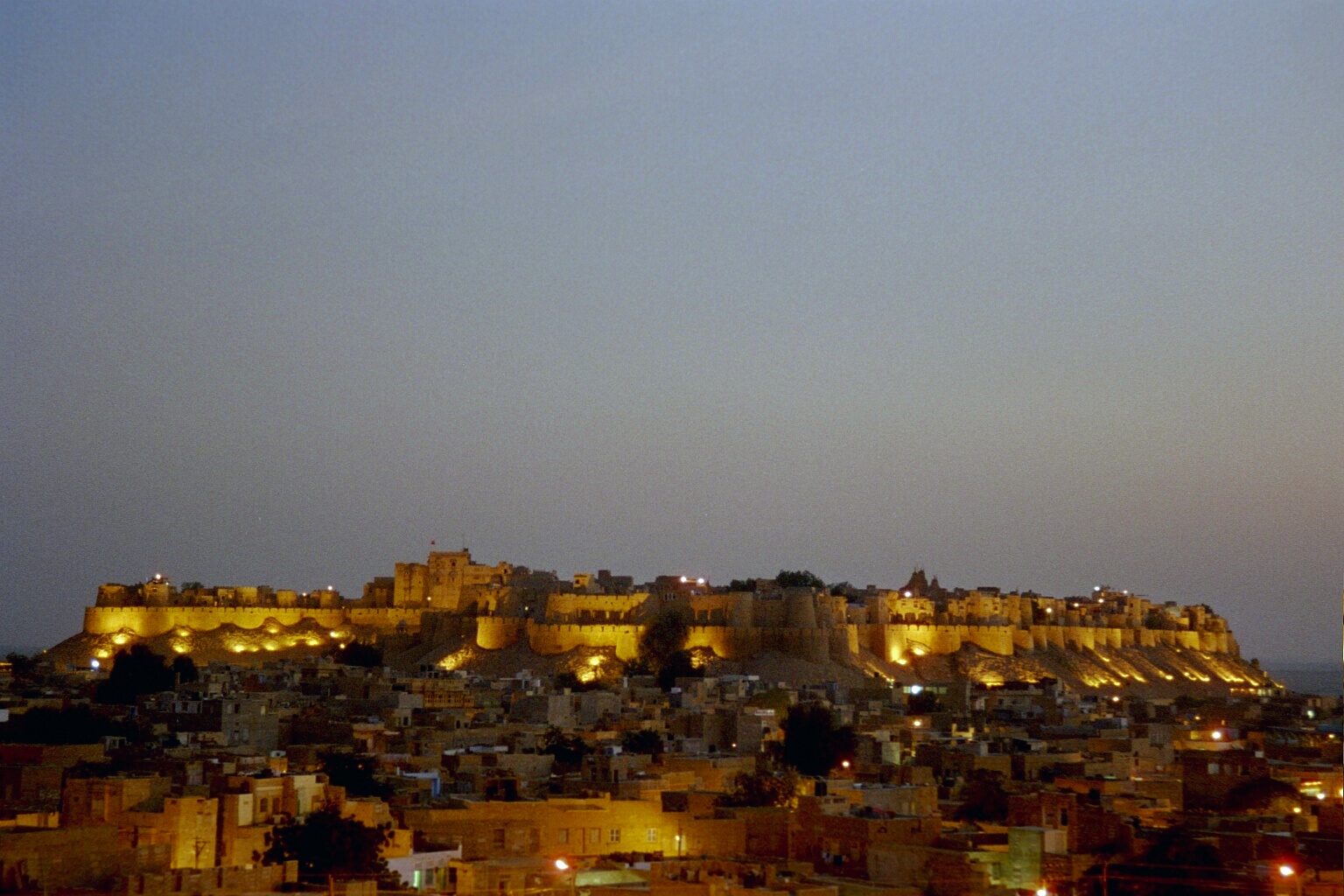
Rawal Jaisal founded Jaisalmer in 1156 on Trikuta hill, and for centuries it prospered on the caravan trade between India, Persia and Central Asia. The merchants who grew rich here built havelis of yellow sandstone carved as finely as wood. When sea trade and Partition cut the routes, the city became remote, which is partly why so much of it survives.
The fort, called Sonar Qila for its colour, is one of the few in the world still lived in. Several thousand people live inside its walls, among Jain temples, palaces, shops and guesthouses. It forms part of the Hill Forts of Rajasthan World Heritage listing. Below it lie the havelis of Patwon, Salim Singh and Nathmal, and to the south, Gadisar Lake, the old reservoir of the city.
Beyond the city the Thar begins: low dunes, scrub, villages of mud and thatch and very big skies. We spend one day on the fort and havelis, one in the desert with the abandoned village of Kuldhara and the cenotaphs of Bada Bagh, and give at least one evening to the dunes with music. Jaisalmer is far from everywhere else, so three nights makes the journey worth it.
Highlights
What Jaisalmer does best
Walk the lanes inside Sonar Qila with a guide: the Raj Mahal palace museum, a group of Jain temples from the 12th to 16th centuries, and houses where families still live. Go early, before the day's heat and visitors.
Five connected havelis built for a family of traders in the early 19th century, with sandstone facades carved like lace. Salim Singh ki Haveli, with its peacock brackets, and Nathmal ki Haveli are close by.
Drive into the desert in the late afternoon, watch the sun go down from a dune away from the crowds at Sam, then eat by a fire with Manganiyar musicians. In winter, the stars are bright enough to need no lamps.
Kuldhara, about 18 km west, is a village of Paliwal Brahmins abandoned in the 19th century, its stone houses still standing in rows. Bada Bagh, north of the city, holds the royal cenotaphs of Jaisalmer on a ridge.
The 14th-century reservoir south of the fort is lined with small temples, ghats and a carved gateway. At sunrise, with the fort reflected and birds on the water, it is the quietest place in the city.
Experiences
Four hours to plan around


Getting there
How to reach Jaisalmer
Jaisalmer Airport (JSA) has had seasonal flights from Delhi, Mumbai and a few other cities, mostly in the winter season. Schedules change from year to year, so check current status before you travel. Otherwise, fly to Jodhpur (JDH) and drive or take the train.
Trains connect Jaisalmer with Jodhpur in about 5.5–6 hours, and with Jaipur and Delhi by longer, often overnight services. The Jodhpur train is a comfortable way to cross the desert and avoids the long drive.
Jodhpur is about 285 km, 5 hours on a good highway across the desert, with a stop at Pokaran possible. Bikaner is about 330 km, 5.5 hours. The Sam dunes are about 42 km west of the city, 45 minutes.
Where to stay
Rooms we book
Suryagarh, a palace-style hotel in golden stone about 15 km west on the Sam road, is our first choice: quiet, comfortable and well organised for desert outings. SUJÁN The Serai, a seasonal luxury tented camp about 40 km from the city, is the best desert camp in Rajasthan when it is open; check current status before you travel. We avoid guesthouses inside the fort for luxury travellers, because of noise, steep access and pressure on the fort's drainage.
A palace-style hotel built in golden Jaisalmer stone on the road to the Sam dunes, about 15 km west of the city. It is the most …
Shape your own journey Tell us your dates and what you hope to feel. We draw the route around you. Begin Not sure where to start? We match the land to your month, your pace and the people travelling with you. Begin Talk to a planner A first route and an indicative price within one working day. No payment to start. BeginFrom our planners
Five things to know
- Visit the fort at opening; by 11 am the lanes are hot and crowded
- Choose a dune area away from Sam for dinner, as Sam itself is very busy at sunset
- Desert nights from December to February fall to 5–8 °C; pack a warm layer
- Ask before photographing people inside the fort, which is a home to its residents
- Areas near the Pakistan border, such as Longewala and Tanot, have rules for foreign visitors; check current status before you travel
Questions travellers ask
Questions about Jaisalmer
How many days do you need in Jaisalmer
Three nights is ideal: one day for the fort and havelis, one for Kuldhara, Bada Bagh and a dune dinner, and a half day to rest or watch sunrise at Gadisar Lake. Two nights works for a shorter journey. Jaisalmer is far from other cities, so one night is not worth the drive.
What is the best time to visit Jaisalmer
October to March. Days are 22–30 °C, nights cool to cold, and the desert is comfortable. February brings the Desert Festival. April to September is very hot, often above 40 °C, and many desert camps close. From December to February desert nights fall to 5–8 °C, so pack a warm layer for dune dinners. Festival dates change each year, so check current status before you travel.
Which is the best hotel in Jaisalmer
Suryagarh, about 15 km west on the Sam road, is the best year-round luxury hotel: quiet, comfortable and well organised for desert outings. SUJÁN The Serai, a seasonal tented camp about 40 km from the city, is the finest camp when open. We often pair one night in camp with nights at Suryagarh, and avoid guesthouses inside the fort. Check current status before you travel.
Is Jaisalmer worth the long drive
Yes, for anyone who wants to see the Thar. The fort, the havelis and nights in the desert are unlike anywhere else in India. Take the train from Jodhpur one way, or fly in on a seasonal flight, to make the journey easier.
Is a desert camp in Jaisalmer luxurious
The best camps have large tents with proper beds, attached bathrooms and good food. Many cheaper camps around Sam are crowded and noisy. We use only a few camps, and usually pair one night in a camp with nights at Suryagarh.
Can foreigners visit Longewala and Tanot from Jaisalmer
Rules for foreign nationals in areas close to the Pakistan border change and may require permission. Indian nationals can usually visit Longewala's war memorial and the Tanot temple. Check current status before you travel; we confirm before planning the day.
How do you get from Jodhpur to Jaisalmer
By car, about 285 km, 5 hours on a good road, or by train in about 5.5–6 hours. We often use the train one way for comfort, with the car going ahead with your luggage. A stop at Pokaran is possible on the drive. Seasonal flights to Jaisalmer Airport run mostly in winter. Train and flight schedules change, so check current status before you travel.
Is Jaisalmer good for families
Yes. Children enjoy the fort, camel rides, dune dinners and the abandoned village of Kuldhara. Suryagarh has space and activities for families. Avoid the hottest months and plan rest in the middle of the day. A camel ride of 30–45 minutes at sunset suits most children, and we choose operators who treat their animals well. Desert nights from December to February fall to 5–8 °C, so pack warm layers for the dunes.
What food is Jaisalmer known for
Desert cooking uses dried beans and berries such as ker sangri, along with bajra roti, kadhi, and ghotua laddoos, a sweet of the city. Ask the hotel for a traditional Jaisalmeri thali one evening. Dune dinners usually include fire-cooked dishes.
Journeys
Routes that stop in Jaisalmer


Nearby
Pair it with

The blue city below Mehrangarh Fort

A desert city of red forts, havelis and bhujia
Shape your own journey Tell us your dates and what you hope to feel. We draw the route around you. Begin Not sure where to start? We match the land to your month, your pace and the people travelling with you. Begin Talk to a planner A first route and an indicative price within one working day. No payment to start. Begin